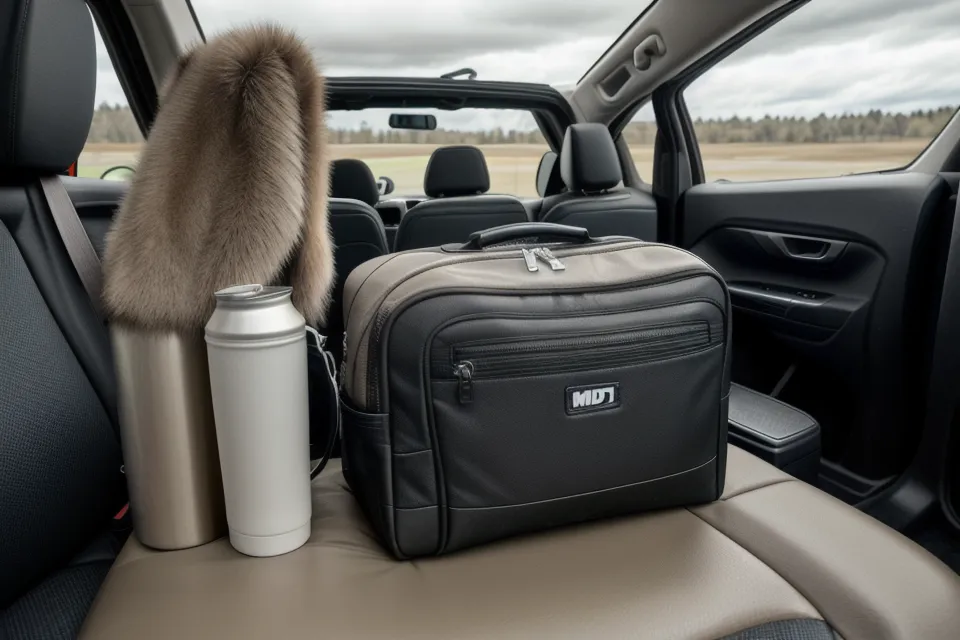
A "Standard SUV" picked up at a Phoenix counter and a "Standard SUV" idling in the Salt Lake City airport rental garage in January can be two completely different machines, even though the booking page shows the identical stock photo. That gap is the reason half the messages I get from other reps flying into SLC for the first time in winter ask some version of the same question: how do you actually know if the car you're assigned has all-wheel drive before you're already merging onto I-80 in a storm. I don't have a clean answer, but I've got a rotation of dozens of these bookings across Salt Lake City, Phoenix, Las Vegas, Denver and Dallas, plus enough winter driving in the Wasatch, to know which parts of the process actually matter. Here's what I tell people who ask.
Does "SUV" on the Salt Lake City Airport Booking Page Mean All-Wheel Drive?
No, and this is the part that costs people money, or worse, a slide on Parleys Canyon. The consolidated rental center at SLC parks every brand under one roof directly across from the terminals, which is convenient right up until a counter agent tells you a "compact SUV" is basically the same as an all-wheel-drive one. It usually isn't. All-wheel drive gets treated in the Mountain West the way legroom gets treated on a regional jet: it's assumed, rarely guaranteed, and worth checking before you're committed. Elevation alone doesn't fix it either; sitting at 4,226 feet doesn't turn every car in a fleet into a mountain goat, and I've pulled plenty of "compact SUVs" out of that garage that turned out to be tall hatchbacks running front-wheel drive.
I used to just take whatever the corporate travel desk booked, back before my expense policy changed in late 2023 and self-booking became my problem instead of someone else's. For a stretch after that I stayed loyal to Hertz Gold specifically to skip the counter line, even on weeks when their rate was clearly higher than what the aggregators were quoting. I was paying extra for a shorter wait, not a better car, and telling myself those were the same thing. They weren't. Standing on a jet bridge at PHX once, stuck behind the usual scrum for a gate-check bag, I watched a listed rate drop twice on my phone before I'd even reached my row. That's when I started keeping my own rental log instead of assuming loyalty status was doing me any favors.
IFAR vs SFAR: The Code That Actually Tells You Something
Forget the photo on the listing and look at the four-letter ACRISS code instead, because that's the only part of the booking that means anything. An IFAR is an "Intermediate SUV" — basically a compact crossover, and no guarantee of real four-wheel-drive hardware underneath. A SFAR is a "Standard SUV," the tier that usually gets you something like a Grand Cherokee or an Explorer, and it's a meaningfully better bet mechanically. Neither code legally locks the agency into handing you AWD on every single contract, which is the part nobody mentions while you're clicking through an aggregator at midnight before a Tuesday flight.
But here's the workaround I've landed on after enough counters: certain aggregators surface the drivetrain tag more honestly than others, so it's worth comparing before you commit rather than after you're standing in line. My notes on Discover Cars cover this in more detail, but the short version is their listings flagged AWD and 4WD more clearly than the portal my old travel desk used to default to. It's a small interface difference until a storm's rolling off the lake, and then it's the only detail that matters.
Utah's Traction Law Changes the Math on AWD
Utah doesn't wait around once snow starts sticking. UDOT can post Traction Law restrictions — Class 1 and Class 2 — on I-80 and the Cottonwood Canyons with almost no warning, and satisfying them means either four-wheel or all-wheel drive, or tires carrying the 3PMSF or M+S rating. Get caught on a 6 percent grade in Parleys Canyon without either while a restriction is active, and you're not just moving slower than everyone else, you're looking at a citation.
Here's the contrarian part, and it took me a full season of these bookings to actually believe it: most rental SUVs in the SLC fleet already carry M+S tires, which satisfies the law on its own. If the plows have been out, and in Utah they usually have, a front-wheel-drive SUV riding on decent all-season rubber handles a plowed highway almost as well as an AWD one does for the average business trip. The AWD badge earns its keep for the thirty seconds you're backing out of an unplowed spot, and the agencies know it, which is exactly why they charge extra for it. I've watched the price gap between a standard SUV and a guaranteed AWD one land somewhere around a decent dinner out. It's noticeable, but not something that changes your month. When the forecast looks clean, I've started taking the standard SUV and keeping the difference.
Checking the Car Before You Leave the Rental Garage
Once you're at the counter, don't ask if the car has AWD, ask if it's four-wheel drive. It's a small phrasing shift, but it tends to get a straighter answer out of an agent who's fielded the same question all shift. Then go look at the tires yourself. The M+S marking is stamped right on the sidewall, and if it's not there, or the tread's already going bald, that's worth a trip back to the counter even if it means holding up the line behind you.
This is also where the car shows up wrong often enough that I've stopped being surprised by it: a different trim than what I booked, a missing second key, a fuel level on the paper contract that doesn't quite match what's actually in the tank. None of that is a dealbreaker on its own, but it's worth catching before you sign, because fixing it in the garage takes two minutes and fixing it after you're on I-15 takes your whole evening. I still fold that paper contract into the sun-visor pocket out of habit, and it's gone stiff and creased by the time I'm turning the car back in a few days later.
What Changes on a Family Trip to the National Parks?
Sales trips are one thing. Spring break with my wife and two kids, headed down to Bryce, Zion and Arches for our yearly self-drive, is a different math problem entirely. A "compact SUV" that's plenty for a solo trip to Dallas turns into a real problem when it's actually holding four people's hiking boots, a cooler and every opinion a 14- and 16-year-old can generate about legroom. That's how I learned a "compact" at one brand and a "compact" at another aren't the same vehicle at all, even with matching category names on the booking page.
A neighbor of mine spends his weekends training for Ragnar Relay races down in southern Utah, and even he's told me about a support-crew SUV that got booked as a crossover and showed up as something closer to a tall sedan — same story, different trip. For the parks run I skip the "Manager's Choice" entirely and book the SFAR code on purpose, because the space matters as much as the drivetrain once the gear's loaded in. This past spring I spent an extra hour cross-referencing what different sites actually had sitting in the garage before booking, because the gap between what an aggregator lists and what's actually there is real, and it shows up more on family trips than sales ones.
None of this is complicated once you know where to look. The annoying part is that it just isn't obvious from the booking page. Check the ACRISS code before the photo, ask about drivetrain instead of AWD by name, look at the actual tires once you're standing next to the car, and treat the AWD premium as optional whenever the forecast is clean and mandatory whenever it isn't. Get that sequence right and the only thing waiting for you outside lake-effect snow territory is a normal drive home to Cottonwood Heights instead of an evening spent waiting on a tow truck.